
I have written a new article on the asset protection qualities of cash value life insurance policies in New York. Please click on the image of the article (below) to view a copy.
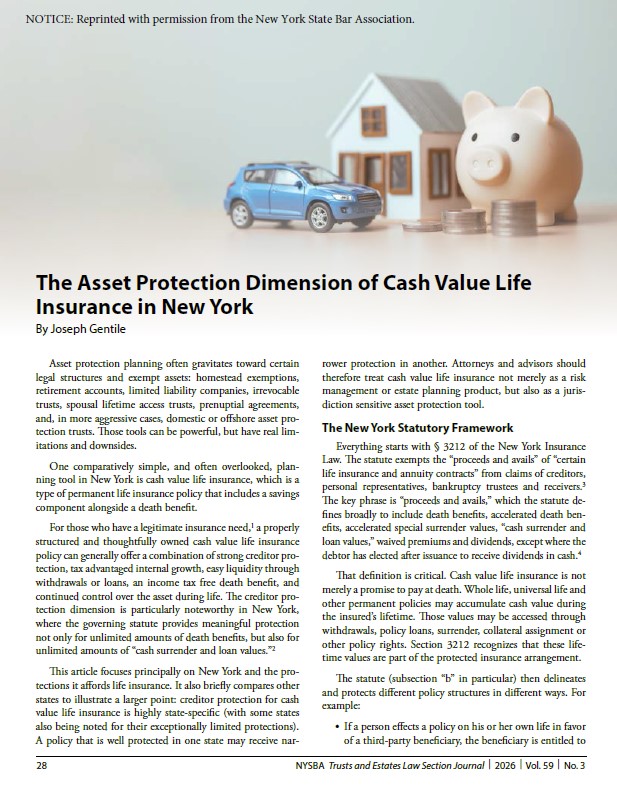 It appears in the latest edition of the Trusts and Estates Law Section Journal which is a publication of the Trusts and Estates Law Section of the New York State Bar Association (NYSBA).
I am grateful for the assistance of the Journal, the Trusts and Estates Law Section and the NYSBA for their help in publishing this work.
I hope the article helps attorneys and their clients navigate this area.
The full text of the article is below which is being reprinted with permission from the New York State Bar Association.
The Asset Protection Dimension of Cash Value Life Insurance in New York
By: Joseph Gentile
Joseph Gentile, is an attorney and licensed insurance broker with a CLU® (Chartered Life Underwriter) designation. He is a member of the law firm Sarraf Gentile LLP, where he has represented insurance policy holders in numerous class actions resulting in settlements exceeding $100 million. He is also the Chief Strategist at Left Tail Risk Advisors, an insurance advisory firm. Lori Epstein reviewed this article and her thoughtful advice and edits are acknowledged and greatly appreciated.
Asset protection planning often gravitates toward certain legal structures and exempt assets: homestead exemptions, retirement accounts, limited liability companies, irrevocable trusts, slats, prenuptial agreements and, in more aggressive cases, domestic or offshore asset protection trusts. Those tools can be powerful, but have real limitations and downsides.
One comparatively simple, and often overlooked, planning tool in New York is cash value life insurance, which is a type of permanent life insurance policy that includes a savings component alongside a death benefit.
For those who have a legitimate insurance need[1], a properly structured and thoughtfully owned cash value life insurance can generally offer a combination of strong creditor protection, tax advantaged internal growth, easy liquidity through withdrawals or loans, an income tax free death benefit, and continued control over the asset during life. The creditor protection dimension is particularly noteworthy in New York, where the governing statute provides meaningful protection not only for unlimited amounts of death benefits, but also for unlimited amounts of “cash surrender and loan values.”[2]
This article focuses principally on New York and the protections it affords life insurance. It also briefly compares other states to illustrate a larger point: creditor protection for cash value life insurance is highly state-specific (with some states also being noted for their exceptionally limited protections). A policy that is well protected in one state may receive narrower protection in another. Attorneys and advisors should therefore treat cash value life insurance not merely as a risk management or estate planning product, but also as a jurisdiction sensitive asset protection tool.
The New York Statutory Framework
Everything starts with section 3212 of the New York Insurance Law. The statute exempts the “proceeds and avails” of “certain life insurance and annuity contracts” from claims of creditors, personal representatives, bankruptcy trustees and receivers.[3] The key phrase is “proceeds and avails,” which the statute defines broadly to include death benefits, accelerated death benefits, accelerated special surrender values, “cash surrender and loan values,” waived premiums and dividends, except where the debtor has elected after issuance to receive dividends in cash.[4]
That definition is critical. Cash value life insurance is not merely a promise to pay at death. Whole life, universal life and other permanent policies may accumulate cash value during the insured’s lifetime. Those values may be accessed through withdrawals, policy loans, surrender, collateral assignment or other policy rights. Section 3212 recognizes that these lifetime values are part of the protected insurance arrangement.
The statute (subsection “b” in particular) then delineates and protects different policy structures in different ways. For example:
- If a person effects a policy on his or her own life in favor of a third-party beneficiary, the beneficiary is entitled to the “proceeds and avails” as against the creditors of the person who effected the insurance.[5]
- If a person effects insurance on the life of another in favor of himself or herself, that person is protected against the creditors of the insured; and if the person effecting such insurance is the spouse of the insured, he or she is also protected against his or her own creditors.[6]
- If a person effects insurance on the life of another for the benefit of a third-party beneficiary, the third-party beneficiary is protected against creditors of both the insured and the person effecting the insurance.[7]
The statute also makes clear that these protections are not lost merely because the right to change the beneficiary is reserved, or because the policy becomes payable to the insured if the beneficiary predeceases the insured.[8] Nor may a person be compelled to exercise policy rights, powers, options or privileges.[9] In short, the statute’s broad protections are themselves shielded from attack.
Supporting New York Case Law
New York courts have long construed this life insurance exemption liberally. In Chatham Phenix National Bank & Trust Co. v. Crosney, the Court of Appeals explained that insurance is “effected” by the person whose money is appropriated and invested in the premiums that create the insurance fund.[10] That concept remains important because the statutory protection often depends on identifying who effected the policy, who is insured, who owns the policy and who is the beneficiary.
New York state and federal courts recognized that protected insurance values are not easily reached by creditors. In Schwartz v. Holzman, the Second Circuit applied New York’s predecessor statute and held that a beneficiary who received surrender proceeds was entitled to hold them against the claims of the insured’s creditors, emphasizing the liberal construction of the statute.[11] Dellefield v. Block likewise recognized that the exemption protected policy values from creditors in circumstances falling within the statute.[12] Kaufman v. New York Life Insurance Co. addressed a creditor’s attempt to reach surrender values and illustrates the importance of distinguishing a mere beneficiary interest from ownership and surrender rights.[13]
More recently, bankruptcy courts and the Second Circuit have addressed the application of section 3212 in joint bankruptcy cases involving spouses. In In re Hickson, the bankruptcy court held that a judgment creditor could not reach the loan or cash surrender value of a policy structure covered by section 3212(b)(2), citing Kaufman, Dellefield and Joint Venture Acquisition v. Misra.[14]
The most important modern appellate authority is Wornick v. Gaffney. There, the Second Circuit addressed whether, in a joint bankruptcy case, the bankruptcy estate of a beneficiary spouse could reach the cash surrender value of a policy taken out by and insuring the other spouse. The court held that the beneficiary spouse’s creditors could not reach the cash surrender value because the beneficiary’s interest was contingent and inchoate; the beneficiary had no present administrative right to surrender the policy.[15] Wornick is significant not merely because it protected the policy values at issue, but because it clarified the relationship among ownership, beneficiary status, and the practical ability to access cash value.
These cases suggest several lessons. First, the New York statute can provide meaningful protection for cash values, not only death benefits. Second, courts will examine the actual policy structure rather than assume that every life insurance policy is protected in the same way. Third, the identity of the owner, insured, premium payer and beneficiary may matter. Fourth, in bankruptcy, the exemption analysis can become more technical because the court must determine what property interests enter the bankruptcy estate and what exemptions apply.[16]
The Planning Benefits: Familiarity, Simplicity & Control
The strongest practical argument for cash value life insurance as an asset protection tool is not that it is exotic. It is that it is familiar.
Unlike many asset protection structures which require some level of relinquishment, a life insurance policy does not necessarily require the client to give up control to a trustee, transfer assets to an entity, create annual administrative formalities or depend on a complex jurisdictional structure. A policy can be purchased from a regulated insurer, titled intentionally, funded over time and integrated into the client’s broader estate, tax and liquidity plan.
For clients who want protection but are reluctant to transfer assets irrevocably, this can be appealing. A business owner, physician, attorney, real estate investor or professional with recurring liability exposure may want to build protected value without surrendering all practical access to the asset. Cash value life insurance may allow the client to retain the ability to borrow against policy value, change beneficiaries, adjust premium schedules, use dividends, or supplement retirement cash flow, depending on the product design.
Control is not absolute. Unpaid policy loans reduce the death benefit and may create tax consequences if the policy lapses. Surrender may trigger gain recognition. Premium obligations can be demanding. The policy must be suitable as insurance, not merely as an asset protection wrapper. But compared with an irrevocable trust, a properly intended and designed permanent life insurance policy can function less like a transfer out of the client’s financial life and more like a protected asset within it.
In addition to being familiar, a life insurance policy (especially a whole life policy), can be simple. It is certainly easier for clients to understand than a lattice of trusts, partnerships and intercompany agreements. The client pays premiums. The policy accumulates values. The death benefit is payable to selected beneficiaries. The policy may be used as a source of liquidity. If New York law applies and the statutory conditions are satisfied, the cash value may receive significant creditor protection.
That simplicity can be especially useful in planning for clients who have moderate wealth and meaningful liability risk, but not enough wealth to justify more elaborate asset protection architecture.
It may also be useful for clients who already own permanent life insurance and have not considered its creditor protection characteristics.
Thus, for those with connections to New York, a life insurance policy can be an excellent complement, but not necessarily a replacement for, more typical asset protection efforts.[17]
Complication One: Fraudulent Transfer and “Too Late” Planning
Creditor protection is not a license to move assets after trouble arrives. New York’s statute preserves creditor remedies where transfers, assignments, beneficiary changes or premium payments are made with actual intent to hinder, delay or defraud creditors.[18] In that circumstance, creditors may recover premiums or other consideration paid with fraudulent intent, with interest, from policy or contract proceeds.[19]
This is a central distinction in asset protection planning. Prospective planning before a claim arises is different from reactive planning after a judgment, threatened lawsuit or insolvency event. A client who buys and funds life insurance as part of ordinary financial planning is in a different position from a client who empties a brokerage account into a policy after receiving a demand letter.
Bankruptcy law adds a related but distinct layer. The Second Circuit has recognized that converting nonexempt assets into exempt assets on the eve of bankruptcy is not, by itself, necessarily fraudulent absent extrinsic evidence of fraud.[20] But that principle should not be overread. Badges of fraud, insolvency, concealment, litigation pressure, unusual transactions and lack of legitimate insurance purpose may all change the analysis.[21]
Complication Two: Policy Structure Matters
The most common error is to speak loosely about “life insurance” as though all policies and all ownership structures are treated identically. They are not.
A policy on the debtor’s own life, owned by the debtor, with a spouse or child as beneficiary, may raise different issues than a policy owned by a spouse on the debtor’s life. A policy owned by an irrevocable life insurance trust raises still other issues unique to such trusts. A policy assigned as collateral to a lender may place some rights outside the exemption. A policy payable to the insured’s estate may weaken protection because the estate is generally exposed to creditors.
The New York statute’s categories are technical. They turn on who “effected” the insurance, whose life is insured, who owns the policy, and who is entitled to the “proceeds and avails.” The cases likewise focus on the legal and practical rights created by the policy. In Wornick, the beneficiary spouse’s inchoate interest mattered because the beneficiary could not surrender the policy.[22] In Mata, by contrast, the court resisted an interpretation under which neither spouse’s creditors could reach value despite the existence of cash surrender rights.[23]
The planning lesson is straightforward: policy design (titling, in particular) should be reviewed before funding. Ownership, beneficiary designation, premium payer and intended source of access should be coordinated. If creditor protection is a planning objective, it should be built into the structure rather than assumed afterward. And finally, a life insurance policy should be periodically reviewed to ensure that it continues to function properly, is adequately funded and meets the intended goals (which may change).
Complication Three: Bankruptcy and Choice of Exemptions
Bankruptcy adds complexity because exemption rights depend on federal bankruptcy law, state law and domicile rules. New York permits debtors to use state exemptions or federal exemptions in bankruptcy, but they cannot simply be mixed and matched at will.[24] The federal exemption for unmatured life insurance and accrued dividends or loan value is materially different from New York’s state-law insurance exemption.[25]
For New York clients, this means that the state-law protection of section 3212 may be highly valuable. But for clients who have recently moved, own policies connected to multiple states (and thus different applicable laws), or may file bankruptcy in another jurisdiction, the analysis must be revisited. Asset protection is often only as strong as the law that ultimately applies.
Complication Four: Not All States Are the Same
New York is comparatively favorable, but it is not alone. Neighboring states and common retirement destinations vary.
New Jersey provides broad protection for life insurance “proceeds and avails” where a policy is effected by a person on his own life, or on another life, in favor of someone other than himself, subject to an exception for transfers made with intent to defraud creditors.[26] That statute is broadly protective, but the precise application depends on policy structure and applicable bankruptcy choices.
Connecticut recently expanded protection for cash value. Connecticut’s post-judgment exemption statute now exempts the cash surrender value of a life insurance policy in unlimited amounts issued on the life of a Connecticut citizen or resident, unless the policy was assigned to or effected for the benefit of the creditor, or the purchase, sale or transfer was made with intent to defraud the creditor.[27] That is a significant improvement over the historically modest protection for cash value.
Florida is among the most protective states. Florida Statutes section 222.14 provides that cash surrender values of life insurance policies issued on the lives of Florida citizens or residents are not liable to attachment, garnishment or legal process in favor of creditors of the person whose life is insured, unless the policy was effected for the benefit of the creditor.[28] Florida separately protects life insurance proceeds payable to beneficiaries other than the insured or the insured’s estate.[29]
In comparison to New York and the others noted above, there are a few cautionary states worth mentioning. Arkansas is a particularly poor example: despite broad statutory insurance exemption, the Eighth Circuit has held that the exemption is limited by the Arkansas Constitution $500 personal-property cap.[30] Similarly, California and Pennsylvania, both of which have statutory protections, demonstrate just how valuable the protection is in New York. California exempts unmatured life insurance policies themselves, but separately limits protection for the aggregate loan value of such policies to a statutory exemption amount.[31] Pennsylvania is narrower still for self-benefiting arrangements: a policy issued to a solvent insured who is also the beneficiary is exempt only to the extent it does not exceed an income or return of $100 per month.[32]
These comparisons underscore the practical point: there is no national rule. A New York client with an out of state residence, an out of state client moving to New York, or a foreign client with policies purchased elsewhere may require a state-specific review. Advisors should not assume that a policy’s creditor protection characteristics travel unchanged across state lines.[33]
When Cash Value Insurance Belongs in the Conversation
Cash value life insurance policies are not all the same and they should not be sold or purchased solely for creditor protection. The policy must make practical and economic sense. Premiums must be sustainable. The client must understand surrender charges, internal policy costs, loan mechanics, tax treatment, lapse risk and insurer strength. Purchasing a poorly designed policy can create disappointment rather than protection.
But for the right client, the asset protection characteristics deserve a place in the planning conversation. Permanent life insurance can serve multiple purposes at once: death benefit protection, estate liquidity, business succession support, tax advantaged accumulation, supplemental retirement flexibility and, in the right jurisdiction, meaningful insulation from creditor claims.
The best insurance planning is sometimes boring in the right way. It will occur before creditors appear. It will be tied to a legitimate insurance need. It will use a structure that fits the statute. It will avoid last-minute transfers. It will account for state law. And it will be coordinated with estate planning, tax planning, bankruptcy liquidity needs and risk.
While real protection may ultimately depend on a court’s view of the debtor’s purpose, such that egregious attempts to defraud creditors may fail, good faith efforts to comply with the statute can afford settlement leverage given the statute’s broad scope. Simply having a life insurance policy in place, and forcing creditors to grapple with section 3212, can increase a debtor’s position in coming to an advantageous resolution with that creditor.
In conclusion, because “proceeds and avails” expressly includes unlimited cash surrender and loan values, cash value life insurance may protect more than families at death; it may protect a living client’s balance sheet during life. For clients exposed to professional, business or investment risk, that protection is too valuable to overlook.
[1] To qualify as life insurance and receive the legal and tax benefits associated with that status, a policy generally must be supported by an “insurable interest” in the life of the insured at the time the policy is procured. An insurable interest exists when the policy owner has a recognized familial or economic relationship with the insured such that the owner would suffer a loss upon the insured’s death. Policies procured by investors or other third parties who lack such an interest are commonly referred to as stranger-originated life insurance (“STOLI”) and have been challenged. Many courts hold that STOLI policies constitute impermissible wagering contracts and are therefore void ab initio. Several states, including New York, have enacted statutes specifically prohibiting STOLI transactions. See N.Y. Ins. Law § 7815.
[2] N.Y. Ins. Law § 3212(a)(1).
[3] N.Y. Ins. Law § 3212(b).
[4] N.Y. Ins. Law § 3212(a)(1).
[5] N.Y. Ins. Law § 3212(b)(1).
[6] N.Y. Ins. Law § 3212(b)(2).
[7] N.Y. Ins. Law § 3212(b)(3).
[8] N.Y. Ins. Law § 3212(b)(5).
[9] Id.
[10] Chatham Phenix Nat’l Bank & Tr. Co. v. Crosney, 251 N.Y. 189, 167 N.E. 217 (1929).
[11] Schwartz v. Holzman, 69 F.2d 814 (2d Cir. 1934).
[12] Dellefield v. Block, 40 F. Supp. 616 (S.D.N.Y. 1941).
[13] Kaufman v. New York Life Ins. Co., 32 A.D.2d 79, 299 N.Y.S.2d 269 (1st Dep’t 1969), aff’d, 26 N.Y.2d 878, 309 N.Y.S.2d 929 (1970). See also In re Rundlett, 153 B.R. 126, 129–30 (S.D.N.Y. 1993) (discussing Kaufman and how ownership is central to determining who had “effected” the insurance for purposes of the statutory exemption.)
[14] In re Hickson, No. 00-20130, slip op. at 8 (Bankr. W.D.N.Y. Aug. 14, 2000); Joint Venture Acquisition v. Misra, No. 90 Civ. 4365, 1992 WL 212352 (S.D.N.Y. Aug. 24, 1992). The same court later took a narrower view in In re Mata, rejecting the idea that reciprocal spousal policies automatically insulated cash values from all creditors where the statutory structure did not support that result. In re Mata, No. 98-11893, slip op. (Bankr. W.D.N.Y. 1999). But, as noted above, this reflects a pre-Wornick split among bankruptcy courts in the Western District of New York over reciprocal spousal policies.
[15] Wornick v. Gaffney, 544 F.3d 486 (2d Cir. 2008). See also In re McDonald, 402 B.R. 568, 571 (Bankr. W.D.N.Y. Mar. 10, 2009) (applying Wornick and permitting debtors to reclaim the cash value of their reciprocal spousal policies as fully exempt under section 3212 despite having previously surrendered the cash value to the bankruptcy trustee pursuant to a turnover order).
[16] See also United States v. Bushlow, 832 F. Supp. 574, 584 (E.D.N.Y. 1993) (where the IRS sought, but failed on summary judgment, to set aside the protections of section 3212 by showing that the debtor “actually intended to defraud the government when he paid the premiums on his life insurance policy”).
[17] In addition to familiarity, simplicity and control, another appealing characteristic of section 3212 is the unlimited dollar amount associated with such protections. While annuities in New York are treated differently, section 3212 includes no dollar limits on life insurance exemptions. This also contrasts favorably with other exempt assets like retirement plans (which have other drawbacks, i.e., early withdrawal penalties, caps on contributions, etc.) and estate tax emptions for foreign national non-domiciles. While other exemptions beyond section 3212 certainly exist, and counsel are advised to survey all possible exemptions when advising a client, they are beyond the scope of this article.
[18] N.Y. Ins. Law § 3212(e)(1); N.Y. Debt. & Cred. Law art. 10.
[19] N.Y. Ins. Law § 3212(e)(2).
[20] In re Adlman, 541 F.2d 999, 1004 (2d Cir. 1976); see also In re Combes, 382 B.R. 186, 190 (Bankr. E.D.N.Y. 2008).
[21] See Bushlow, supra n. 15.
[22] Wornick, 544 F.3d at 490-92.
[23] In re Mata, No. 98-11893, slip op. at 4.
[24] N.Y. Debt. & Cred. Law § 282; 11 U.S.C. § 522(b).
[25] 11 U.S.C. § 522(d)(7), (8).
[26] N.J. Stat. Ann. § 17B:24-6.
[27] Conn. Gen. Stat. § 52-352b(20).
[28] Fla. Stat. § 222.14.
[29] Fla. Stat. § 222.13.
[30] Ark. Code Ann. § 16-66-209; In re Holt, 894 F.2d 1005 (8th Cir. 1990) (holding that “section 16–66–209 is unconstitutional as applied to debtors in bankruptcy because it is in direct conflict with the overriding $500 limitation imposed by article 9, section 2”).
[31] Cal. Civ. Proc. Code § 704.100(a)-(b); Judicial Council of Cal., Current Dollar Amounts of Exemptions from Enforcement of Judgments, Form EJ-156, at 2 (eff. Apr. 1, 2025) (listing the aggregate loan value exemption for unmatured life insurance policies currently at $17,525); In re Woodson, 839 F.2d 610, 618 (9th Cir. 1988) (holding that the ownership interest in an unmatured policy is exempt while its policy loan value is protected only up to the statutory cap).
[32] 42 Pa. Cons. Stat. § 8124(c)(3).
[33] Section 3212 does not, on its face, have any limiting jurisdictional requirements and appears to apply whenever New York law is applicable. In bankruptcy, that usually turns on the debtor’s domicile under Bankruptcy Code § 522 and New York Debtor & Creditor Law § 282. Outside bankruptcy, it typically turns on ordinary New York enforcement, choice-of-law, and judgment-enforcement principles.


